Articles
Finished training sits unlaunched because most of the company was never added to the platform. Here is how to gate, send, and chase every seat you buy.
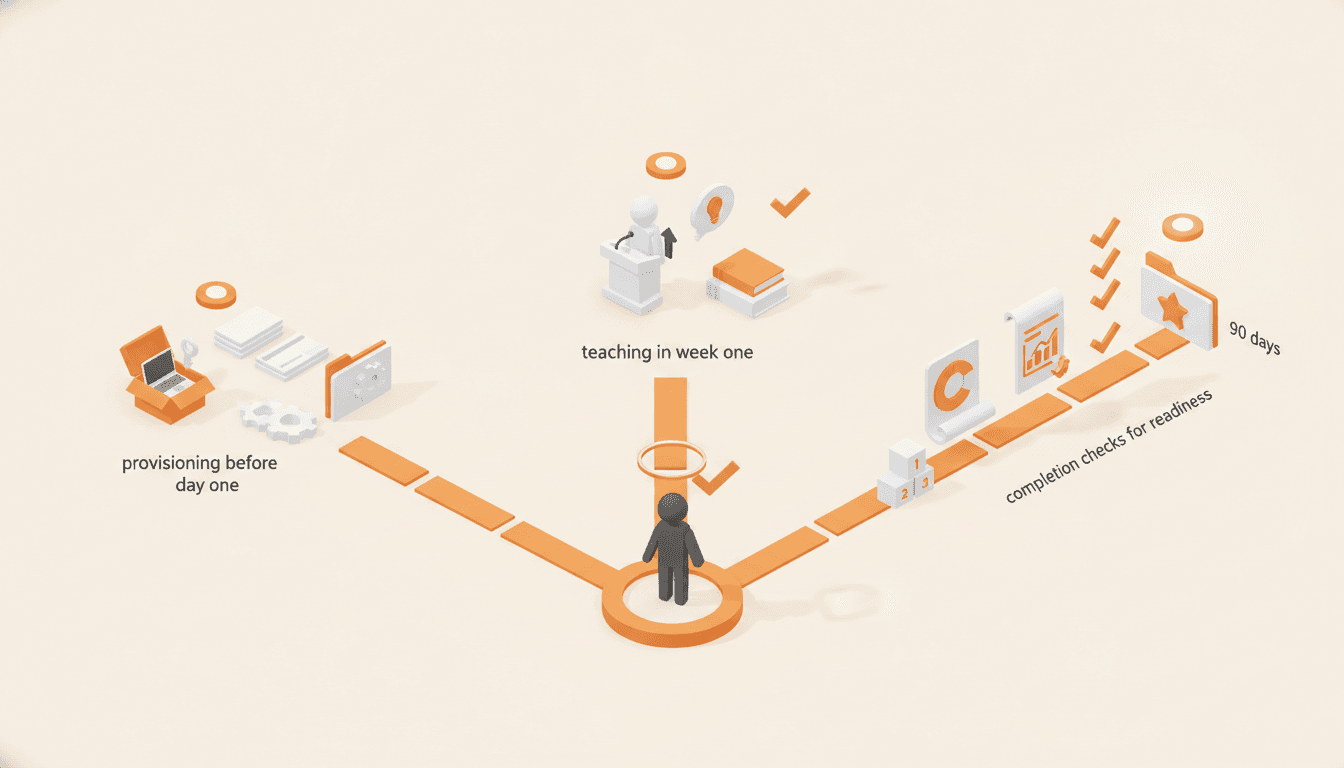
A 90-day onboarding checklist for small businesses: what to provision before day one, what to teach in week one, and the completion checks that prove a new hire is ready.
A trainer rejected three usable takes of her own script in a row, then named the fix herself: turn the camera on and ask questions. Here is the recording format that gets a fluent expert on tape in one sitting.
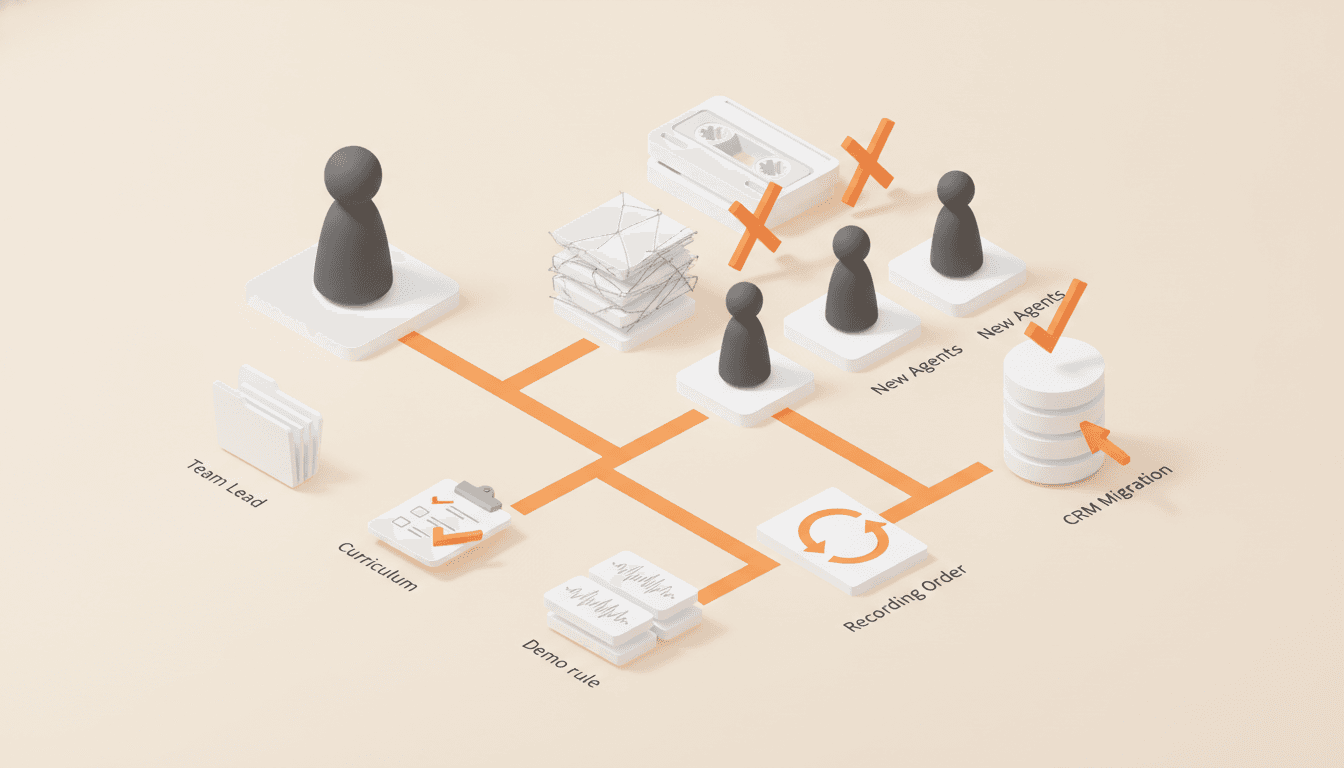
The person who trains new agents is usually the top producer, which is why agent training stalls at three half finished videos. Here is the curriculum, the demo rule, and the recording order that survives a CRM migration.
Integrity on a plaque changes nothing. Here is how to surface the values your team already runs on, write each one as a behavior somebody can do, and use them where it costs you something.
A skills matrix is a grid of processes against people, scored by what each person can run alone today. Here is how to build one, score it so the numbers mean something, and read the row that should worry you.
Your SOP library is not a training program yet. Here is the five step conversion: group by role, sequence the path, add the why, track completion, and launch at 80 percent.
Most small businesses hand training to whoever is best at the job, then wonder why it does not transfer. Here is how to pick an internal trainer, equip them with a script and a rubric, and measure them on what the new hire can do alone.
Watching someone do the job is not training, it is proximity. Here is why shadowing produces three versions of every process, and what to build in its place.
An exit interview asks someone who has already gone why they left. A stay interview asks while they are still here, and the same hour surfaces the work only they know how to do.
One question finds more onboarding gaps than any survey, because of how it is phrased. Here is the question, the four follow-ups that keep the answers coming, and what to build from each one.
You opened the floor, asked for brutal honesty, and got a room full of nodding. The silence was not apathy, it was a correct read of what it costs one person to speak.
New hires learn whatever the queue sends them, which is how someone ends up two weeks in, confident on two case types, and lost on the third. A training caseload fixes the order.
Cross-training dies in busy weeks because it gets scheduled like a training program instead of bought like coverage. Here is the version that survives: rank by damage, one named backup per critical process, and a real shift as the test.
Most 30-60-90 day plans list meetings and reading. Write yours as a handoff schedule: what a new manager learns, runs, and permanently takes off the owner's plate.
The operational close-out most small businesses improvise: access, equipment, money owed in both directions, the recorded knowledge handoff, and the audit two weeks after the last day.
Your new reps are practicing on somebody, and right now it is your customers. Mock call training moves that practice into a scheduled session scored on a written rubric.
Teams revert to spreadsheets and group chats because those paths are faster than a new tool. Real adoption comes from making the new way cheaper, removing the fallback, wiring the tool into the daily rhythm, and leading by example.
Most training fails because it was built to be sat through instead of used. Five design moves make training engaging enough that people finish it and apply it.
Emailing a document to thirty people is not a training system, it is the absence of one. This guide lays out the four-layer Department Training Stack: one source of truth, role-based paths, verified completion, and manager ownership.
Retraining a veteran employee is change management disguised as training. This guide covers leading with the business reason, making veterans co-authors of the new standard, and winning the hardest skeptic first.
A dead Trainual account is almost always a culture and strategy failure, not a software failure: nobody logs in because the current answer still lives in a manager's head or a chat thread. Here is how to make the platform the one place that answer lives.
A team saying "our training isn't good" is reporting a symptom, not a diagnosis. Here are the six root causes behind ineffective employee training, and the six-question audit that tells you which ones are yours.
A process-based culture is one where the documented way is the real way. Here are the six ordered moves that turn SOPs nobody opens into how your team actually works.
Teams ignore SOPs because not following the SOP is easier than following it. Here is the five-move Adoption Loop that makes the documented way the easy way, and the four fixes that never work.
Launch your playbook when it is roughly 80% done and let the people doing the work finish it. Waiting for perfect is what keeps most training projects from ever reaching the team.
Most small businesses put 60 to 70 percent of overhead into salaries and about 1 percent into training those same people. That gap is why companies stall instead of scaling, and closing it starts with one playbook built to 80 percent.
SOPs get followed when using them is faster than figuring the task out from memory. Here is how to write SOPs your team will actually follow: the right author, a scannable format, and a rollout with a named owner and a review date.