How to Cross-Train Employees Without Slowing the Team Down
By Derek Coffey · August 29, 2026 · Updated August 30, 2026
Cross train employees by starting where the business breaks, not where it feels fair. Find the processes only one person can run, give each exactly one named backup, transfer the work with a recording turned into an SOP, and prove it with a real shift. Done that way, cross-training costs a few hours a month. Done as everyone learning a little of everything, it dies in the first busy week.
Key takeaway: Rank processes by how few people can run them and how fast the damage lands, then name one backup for each. Record the holder doing the work instead of asking for a write-up, and count nothing transferred until the backup has run it alone.
Why does cross-training lose to the daily fire?
Cross-training loses because it bills you today for a problem with no date on it. The hours come out of production, and the payoff stays invisible until the week it is the only thing keeping the lights on.
One electrical contractor kept a coordinator who had gone quiet for years, tolerating stalled projects, because "we are not built well for turnover." That is a company that knows it has no bench.
Then the bill arrives at once. A staffing firm had its customer service team cut to two people overnight and needed training for hires nobody had posted yet. That is the real cost, and it lands as what breaks when your one key person calls in sick.
Cross-training never loses the argument, only the calendar.
It is not a training program. It is coverage, bought in hours, before the hours get expensive.
Start from your single points of failure, not from fairness
Rank by damage. A knowledge risk assessment is a ranking of every process by two things: how few people can run it, and how much breaks when it stops. Sort on those and the cross training plan writes itself.
Fairness kills the plan: spreading training hours evenly leaves the dangerous rows as exposed as they were.
Three questions produce a usable score:
- Name what stops. Which jobs, invoices, or decisions halt if this person is out two weeks.
- Count the holders. How many could run it tomorrow unassisted. One is a single point of failure, and zero is common.
- Time the damage. How long before a customer, a paycheck, or a regulator notices.
Cross-train in the order the damage arrives, not in the order the org chart is drawn.
At one field services company, routing was the bottleneck, and the owner put the cost of getting it wrong near 30 percent of revenue. One dispatcher held all of it. When one person holds the whole thing, you hear the same phrase in interviews: "if she leaves, we are in trouble."
How to cross train employees: build the coverage matrix first
A cross training matrix is a grid with your critical processes down the side and your people across the top, scored by what each person can do today. It takes about an hour.
Score every cell 0 to 3: 0 means never done it, 1 means supervised only, 2 means they can run it alone start to finish, and 3 means they have trained somebody else to a 2.
| Process | Owner | Ops lead | Dispatcher | Bookkeeper |
|---|---|---|---|---|
| Weekly commission run | 1 | 0 | 0 | 3 |
| Daily routing | 1 | 2 | 3 | 0 |
| New job intake | 2 | 2 | 2 | 0 |
| Vendor payables | 2 | 0 | 0 | 3 |
Read the rows, not the columns. If only one person on a row scores above a 1, that process leaves the building when they do. The bookkeeper in that grid was three weeks from her last day when we scored it.
The trap is scoring from memory, which runs high every time. Make a 2 mean something specific: they ran it alone in the last six months and nobody fixed it after. When we measured 16 small businesses across 68 roles and 461 process areas, 27 percent of the work was documented and half the role areas had nothing.
Three people scoring a 2 on one row can still be running three different processes, which is the quiet failure inside shadow-based training.
One backup per critical process, not everyone on everything
Every critical process gets exactly one named backup. Not two, not the team, one.
The math is the reason. Twelve processes across eight people is 96 cells, and nobody finishes that. Twelve processes with one backup each is 12 transfers, closable in a quarter.
Pick the backup by adjacency, not availability. Whoever already touches the process needs the least training and gets natural repetitions afterward.
Two cases where a backup is the wrong buy: a process that changes shape every month, because you will train the version that dies, and a role you are already planning to outsource. Keep the transfer hours for rows that will still exist next year.
Name the backup in writing and tell both people. An unnamed backup is a hope.
The opposite failure costs the same. One cleaning company had an office "team" that was really one bucket labeled anyone-who-answers-the-phone, so everybody backed up everything and nobody owned anything. When you are training a large department of 30 or more people, the rule tiers: one backup per process, then a second tier once the first is proven.
Use the SOP as the transfer, the shift as the test
The transfer is not a meeting. It is a document built from a recording, followed by a shift the backup runs alone.
Never ask the holder to write down how they do the job. You get the tidy version, minus every workaround holding the thing together. Record the real work instead, and capture three layers: why the process exists, where the decisions get made, and the steps in their own order.
When we recorded an exiting bookkeeper at one field services company, one weekly process took 85 minutes just to narrate: two reports merged with a VLOOKUP because the export strips the job IDs, screenshots of group chats to find who worked the job, receipts hunted through a login she did not have. None of that survives a write-up.
Then run the test. The backup works a real shift, the expert sits in the room and stays quiet, and whatever breaks gets patched into the document that night. Sitting beside somebody for two days is not a transfer. A solo run is.
That run will cost you one slower, messier day on live work, so book it on a light week instead of your peak season.
The same machinery drives a knowledge transfer plan when a key person leaves, and feeds a new hire onboarding checklist through the first 90 days.
Rotate deliberately: the vacation as a drill
A backup who has not touched the process in eight months is not a backup. Skills decay and the document goes stale in the places nobody reads.
You do not need to invent a training week. You already own a rotation calendar and it is called PTO. One electrical contractor planned two weeks away and treated his own absence as the measurement, expecting honest feedback because nobody would be waiting on him.
Coverage you have never tested is not coverage, it is a name in a spreadsheet.
Four rules make it a real drill: announce which processes are tested, tell the holder not to answer the phone, log every question asked anyway, and patch the document that week.
Every critical row gets exercised at least twice a year, and a scheduled vacation is the cheapest drill you will ever run.
How much cross-training is enough?
Enough is one trained backup per critical process, proven by a solo run in the last six months. You are not trying to get everyone to a 3 on everything.
Measure it as one number: critical rows with at least one person at a 2, divided by total critical rows. A company at 100 percent on 12 critical processes beats one at 40 percent across 60.
Put hours against each transfer and the debate stops being philosophical. Capturing one process yourself takes a few hours of the holder's time, and two supervised runs close it out, so about a day of combined time buys permanent coverage. Weigh that against the owner who took payables back after a key person left and found 500 to 800 dollars leaking weekly, up to 10,000 dollars a month.
The Systems Effect does the capture half of this work, interviewing the person who holds the process and turning the recording into the SOP and process map the backup trains from.
Open a spreadsheet this week. Ten processes down the left, your people across the top, honest scores in the cells. The first row carrying a single 2 is where your cross-training starts.
Frequently Asked Questions
How do you cross train employees in a small business?
Start with the processes only one person can run rather than a general training plan. List your critical processes, score who can run each alone today, and give every single-holder row one named backup. Transfer each by recording the holder doing real work, then having the backup run a shift alone.
What is a cross training matrix?
A cross training matrix is a grid with your critical processes down the side and your people across the top, each cell scored by what that person can do today. The scale runs 0 for never done it, 1 for supervised, 2 for alone, 3 for can teach it. Keep it to ten or twelve critical processes rather than every task in the business, or the grid gets too large to score honestly and too stale to maintain.
Which roles should be cross trained first?
Rank by damage, not by title. Ask what stops when the person is gone two weeks, how many could run it tomorrow unassisted, and how long before a customer or a paycheck is affected. The processes scoring highest on all three come first, and they often sit well below the top of the org chart.
How do you cross train without hurting productivity?
Cap the scope and use work you are already doing. One backup per critical process instead of everyone on everything cuts the transfer count by an order of magnitude, and recording a live session costs the expert almost nothing beyond the time the task already takes. Use planned vacations as the solo runs and budget about a day per process.
Keep reading
Nobody Spoke Up: How to Get Honest Answers From Your Own Team
You opened the floor, asked for brutal honesty, and got a room full of nodding. The silence was not apathy, it was a correct read of what it costs one person to speak.
How to Train New Real Estate Agents (When You Are Also Their Team Lead)
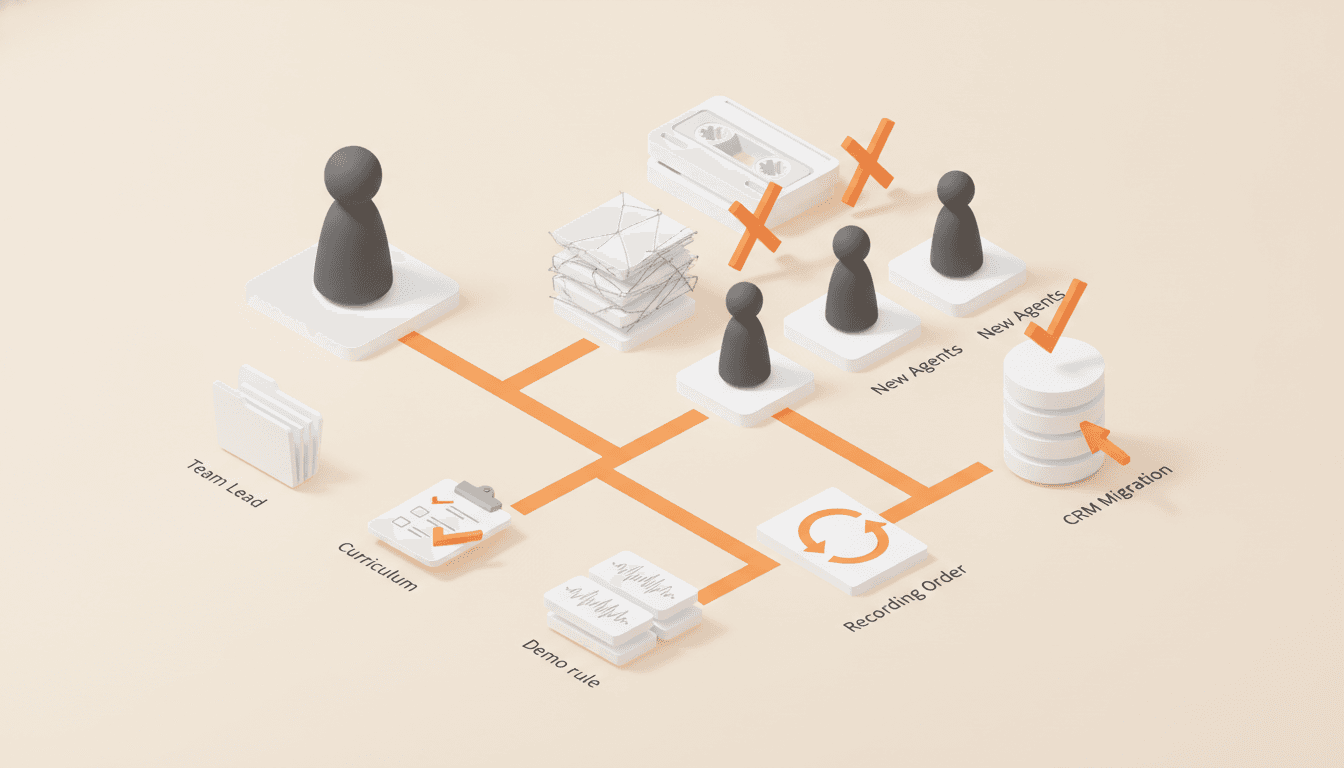
The person who trains new agents is usually the top producer, which is why agent training stalls at three half finished videos. Here is the curriculum, the demo rule, and the recording order that survives a CRM migration.
Core Values People Actually Use (Not Wall Art)
Integrity on a plaque changes nothing. Here is how to surface the values your team already runs on, write each one as a behavior somebody can do, and use them where it costs you something.
Get one role out of one person's head in 14 days.
The interview guide, knowledge map and SOP templates we use on paid engagements. Free as Google Docs and Sheets.