
To write core values for a small business that people actually use, stop inventing words and read the behaviors your best people already run on. Collect them from the team, cut the list to 5, write each one as something a person can be seen doing or failing to do, then use them in hiring, coaching, and firing. An electrical contracting client hung his values where every employee walked past. Integrity was one, and it changed nothing about who he hired, coached, or let go.
Why integrity on the wall changes nothing
Values fail because they are nouns. Integrity, excellence, and teamwork name qualities, and nobody has ever watched a person perform a quality. That owner called his own list things you should not have to say, which is the tell. Nobody can be measured against a value nobody could argue with.
Ask an owner with a plaque which candidate he turned down over value number 3, and you get a pause.
A value that has never cost you a hire is not a value, it is a decoration with a font.
The real values transmit anyway, through whoever the new hire stands next to in week one. That is what makes shadowing a veteran a weak way to train: it copies everything that person does, including the parts you would never approve.
Do not invent your values, find the ones already there
Your company already has values. They were set by what it survived, not by a workshop.
One contractor described his culture as forged by nearly failing in the 2008 crisis: a get-it-done resilience and one hard rule, you do what you say you are going to do. That rule was carved into the place, but nobody had written it down, so it could not be taught, hired for, or enforced. The work was not inventing values, it was reading them.
We find them by listening for heat. If there is an emotion behind something, it has already turned into a law for that person. Ask about the year that nearly ended the company, the customer he fired, the employee he kept two years too long. Where the voice changes, a value sits underneath.
If you cannot point to a year, a customer, or a decision that proves a value, it is not yours yet.
The sticky note exercise that surfaces real behaviors
Do not ask a room what the company should stand for; you will get the plaque back in their handwriting. Ask about each other instead. An outside board advisor ran this with a contractor's leadership team, and it fits in one meeting.
- Hand out sticky pads. Everybody gets one, including the field, because a foreman and an office coordinator name different behaviors.
- Ask about the best peers. The prompt is the behaviors you admire in the people who are best at this work. Not values, not adjectives: what your best foreman does on a bad Tuesday.
- One behavior per sticky. Anyone splitting a thought across two stickies was describing two different things.
- Read them out loud. The pattern becomes visible, and somebody usually admits they never knew a colleague worked that way.
- Let the owner go last. If the owner writes first, everyone else writes a version of what the owner wrote.
Thirty stickies in your team's own words beat a polished list brought in from outside, for the same reason participation is what gets a team to actually follow SOPs. People defend what they helped build; nobody defends a memo.
This is the wrong exercise under about 10 people or inside your first two years. There is not enough shared history for a room to name a pattern, and what surfaces is the owner's own rules with extra steps.
Keep, kill, combine: how do you get from 30 behaviors to 5?
Sort the wall into three piles, in this order.
- Keep: named by more than one person, and you can name the employee who does it.
- Kill: true of any functioning company. Shows up on time. Table stakes are not values.
- Combine: three stickies saying one thing three ways. Merge them, keep the sharpest wording.
Then the owner takes the pile away and makes it his. That order only works one way: team first, owner second, so their fingerprints stay in the wording.
Stop at 5, because nobody coaches against a list they cannot recite from memory in a truck.
How do you write core values for a small business? Write behaviors, not nouns
You write each value so a person can be observed doing it or failing to do it. That is the whole rule. Run every survivor of the keep pile through it.
| Noun on the plaque | Behavior you can watch |
|---|---|
| Integrity | You do what you say you are going to do |
| Accountability | Bad news travels fast, and upward |
| Teamwork | Nobody leaves a crew short without calling it |
| Excellence | The work gets checked before the customer sees it |
Every phrase in the right column can be violated on a Tuesday afternoon, by name, in front of witnesses. A value that cannot be broken cannot be coached, and one that cannot be coached is wall art with better typography.
Then attach the story that formed it. Telling someone to do something is one thing; leading them through relatability and experience is where it sticks. The bad news rule exists because of one job that went sideways while everybody stayed quiet, the same discipline behind safety rules that stick because the incident story rides along.
Use them in hiring, coaching, and firing, or drop them
A value earns its place the first time it costs you something. Until then it is a candidate.
In hiring, each value becomes one interview question that asks for a time, not an opinion. Nobody fails do you believe in accountability. Plenty of strong candidates cannot produce a story about telling a customer bad news early, and that gap is the signal.
In coaching, a written behavior gets you the conversation months earlier. One contractor had a coordinator who went quiet for years: no proactive updates, projects stalling, the owner reduced to sending reminders like a personal assistant.
With a behavior on paper the conversation is about updates in the channel, not character, and it happens in month 2 instead of year 3. Ask whoever already teaches the work to model it, which is why an internal trainer is a named seat and not a favor.
In firing, behaviors separate right person wrong seat from wrong person. A skills problem is work that misses the mark. A values problem is the same behavior failing in every seat you move them into. If a value has not shaped a hire, a coaching conversation, or an exit in the last year, take it off the wall.
Roll it out without the Moses moment
Roll out slowly, with the team's own words in front of them. The failure mode has a name in the field: an operating system that lands like Moses coming down from the mountain. One contractor had his system printed on a single page, 45 by 36 inches. A beautiful artifact, delivered wrong, which is the fastest way to make a room feel handed something.
- Give it back first. Show the room their own stickies next to the final 5 before you announce anything.
- Perfect these two only. Core values and the growth engine that pays everyone are worth polishing before rollout; everything else can ship rough and improve in place. Rolled out poorly, values become dead words on a wall.
- Lead with a decision. Announce each value alongside a real call you made using it, ideally one that cost you, then name the meeting that changes this week.
Skip that step and the rollout joins the graveyard of every unused tool in the building, because teams resist new tools for reasons that are usually rational. Values die the same way.
What do you do when the team shrugs?
Assume the shrug is accurate. One owner named his own fear before the rollout: here comes the boss again, throwing a lot of stuff at us while we are just trying to do our day job. If nothing about their week changes, he was right.
The shrug is not apathy, it is an accurate read of a week that did not change.
The objection underneath is that my team is not executives, so why would they care. They do not need to. Simplify their process first, support them in it, and the bandwidth shows up on its own. Then find the two or three who already take ownership of their own lives and let them be lighthouses.
That is what a process-based culture is: structure that makes the right behavior the easy one.
At The Systems Effect we sit with the people who hold a company's unwritten rules and write down what is already true, values included. Pick one of your 5 this week and use it out loud in a real decision, in front of the person it affects.
Frequently Asked Questions
How do you write core values for a small business?
Collect behaviors from your team instead of writing values yourself. Run a sticky note round where everyone names what they admire in your best people, sort into keep, kill, and combine piles, and stop at 5. Write each survivor as something a person can be seen doing or failing to do.
Why do most company values fail?
Because they are nouns nobody can argue with, and because they never touch a real decision. Integrity and excellence cannot be observed, coached, or violated, so they change nothing about who gets hired or fired. A value that never cost you a hire is a decoration.
How many core values should a company have?
Three to 5, and 5 is the ceiling. The test is whether a foreman can recite the list from memory and make a call without checking a document. Every value past the fifth dilutes the ones ahead of it.
How do you get employees to buy into company values?
Have them write the raw material, then show them their own words inside the finished list. People defend what they helped build and ignore what arrives finished, which is why a rollout that opens with an announcement ends in a shrug. Attach the story behind each value; experience sticks where instructions do not.
What is the difference between a value and a behavior?
A value is a quality you claim, and a behavior is an action someone can be observed doing or failing to do. Accountability is a value. Bad news travels fast, and upward, is a behavior. Only the second can be interviewed for, coached against, and enforced.
Keep reading

Mock Call Training: How to Coach Reps Before Real Customers Do
Your new reps are practicing on somebody, and right now it is your customers. Mock call training moves that practice into a scheduled session scored on a written rubric.
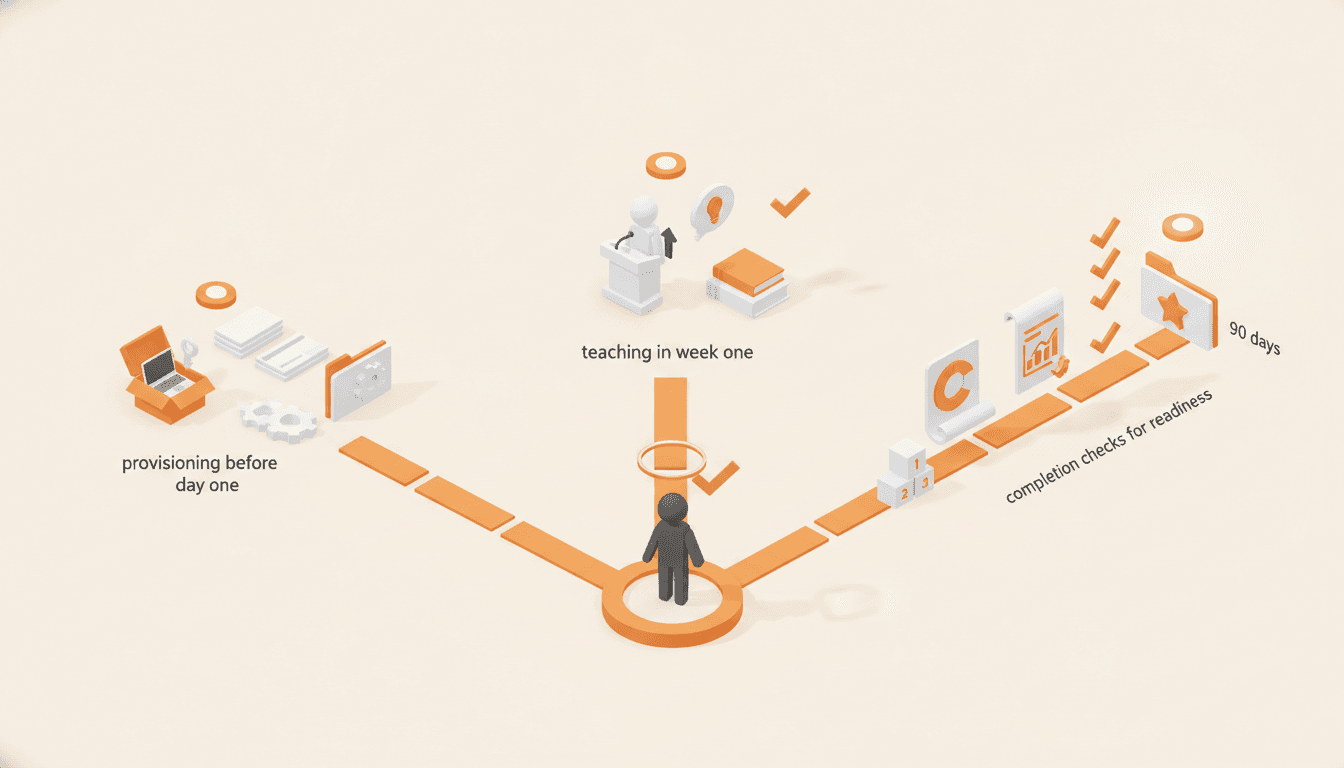
The New Hire Onboarding Checklist for Small Business (First 90 Days)
A 90-day onboarding checklist for small businesses: what to provision before day one, what to teach in week one, and the completion checks that prove a new hire is ready.

The Queue Is Not a Curriculum: Build a Training Caseload
New hires learn whatever the queue sends them, which is how someone ends up two weeks in, confident on two case types, and lost on the third. A training caseload fixes the order.
Get one role out of one person's head in 14 days.
The interview guide, knowledge map and SOP templates we use on paid engagements. Free as Google Docs and Sheets.