No-Code vs Custom Software: When the Low-Code App Stops Being Enough
By Derek Coffey · August 29, 2026
No-code vs custom software is not a quality contest. A no-code build is an app your own people assemble on a platform somebody else owns and updates. Custom software is an application built for your workflow that you keep. Most internal tools should start in no-code, because it is cheaper to be wrong there, and a small number of them should eventually leave.
The short answer
Build it in no-code first. Move it to custom software when the workflow it holds is how you make money, when the judgment inside it is more than the platform can express, or when the vendor's limits start making your operating decisions for you.
That rule runs in both directions, and the second half matters more than owners expect. Most of what a small business needs internally is a shared spreadsheet with permissions on it, and a low-code builder does that job in a week for the price of a few seats. The workflows worth owning are the handful that make you different from the company across town, which is the same line that decides whether you own your software or rent it.
If the process is how you make money, own it. If it is a chore every business in your industry runs the same way, rent it.
What do no-code platforms genuinely solve?
They close the gap between a spreadsheet and a software project, and that gap is where most small businesses actually live. One electrical contractor we work with runs its job boards and bid boards inside a low-code app builder that came bundled with the office suite the company already paid for. Around 30 people in the field depend on those boards. Nobody hired a developer, and nothing about that arrangement is a consolation prize.
Four jobs in particular land well in a no-code tool. A form replaces a paper clipboard, and a shared record replaces a group chat thread nobody can search. A simple dashboard replaces the whiteboard in the dispatch room. A queue with permissions replaces the reply-all approval that used to sit in somebody's inbox.
The undersold benefit is diagnostic. Standing a process up in a cheap tool is the fastest honest test of whether the process exists at all. If people will not use it when it costs a weekend, they will not use it when it costs a quarter's budget.
The four walls every no-code build eventually hits
The limits show up in a predictable order, and none of them appear in the first month.
- The data wall. Your records live in the platform's shape, not yours. At one field services company we mapped, the CRM strips the unique job codes out of every export, so a second report and a manual merge now exist purely to undo what the software broke. When the data model belongs to the vendor, the repair work belongs to you.
- The logic wall. Every real process has forks where the right answer depends on context, and those decision points are the first thing a low-code build flattens. The tool holds the steps happily. It struggles to hold why your best estimator prices one job differently from the one that looks identical on paper.
- The maintainer wall. One person quietly becomes the platform. At that same field services company, the operations lead rebuilds the reporting pipeline roughly every 6 weeks, because any marketing change snaps the match key he had to invent himself, and then he re-audits 6 weeks of numbers he can no longer trust. The owner has no idea how much effort keeps those dashboards alive.
- The vendor wall. Per-seat pricing turns headcount into a recurring software bill, and the roadmap you are building on is not yours. You are always one decision away from a crisis you did not make: a price change, a sunset plan, an acquisition, new terms with 30 days notice. As of this writing most no-code platforms bill per user, per app, or per record, so confirm current numbers before you model what growth does to the invoice.
Read those four together and a pattern shows up. Nothing on the list is a missing feature, which is why comparing feature lists never predicts the wall you hit.
A no-code app is a room you fit out inside somebody else's building, and the lease decides how far the walls move.
No-code vs custom software: side by side
The honest comparison is not about capability, because both approaches can produce a working app. It is about who holds the ceiling.
| No-code build | Custom software | |
|---|---|---|
| First version | days to weeks | weeks to months |
| Who changes it | an operator | a developer, or you |
| Cost shape | per seat, forever | project cost, then upkeep |
| Ceiling | the platform's model | your process |
| Data | vendor's schema and export | yours, portable |
| Growth | headcount raises the bill | headcount is free |
| At sale | a login the buyer re-subscribes to | an asset that conveys |
| Usual failure | quietly outgrown | over-scoped up front |
Only two of those rows describe software. The rest describe ownership, and ownership is the thing you are actually choosing between. A scatter of small no-code apps also rebuilds the silo problem it was bought to fix, each one holding its own copy of the customer, which is why one connected system your business runs on is a different goal from a shelf full of tools.
The abandoned internal app problem
The common outcome for an internal build is not failure. It is abandonment.
A real estate investment company had built its own SOP platform on a low-code tool before we ever spoke to them, and then stopped using it. The content was still in there. Nobody opened it. Meanwhile the person holding the operating knowledge for the whole portfolio was planning to retire within about 3 years, the exact risk the platform had been built to catch.
Three things kill an internal app, and none of them is a technical limitation. It was built by one enthusiast who moved on. It encoded a process the team had never actually agreed on. Or it asked people to remember to open it, which is the quiet killer.
A program manager at a nonprofit put the blank-canvas version of this perfectly: the empty space does not really say much, and adoption dies at the empty screen. An operations lead in field services named the same failure from the other end. The biggest source of friction is manual work, and manual work is where the process gets forgotten.
Nobody abandons the app that stands between them and getting paid.
An internal app that people have to remember to open has already been abandoned, it just has not been deleted yet.
What does it cost to move off a no-code tool later?
More than the export button suggests, and less than starting from nothing. Four costs show up every time: rebuilding the logic that only ever existed inside the platform, untangling data stored in the vendor's shape, retraining everyone on new screens, and running both systems in parallel while you prove the new one.
The harder cost is the year you spend not deciding. An operations manager we interviewed described the trap in one sentence: you are always in the space where you start to outgrow something but you are not quite big enough for the next thing. His owner asked the obvious follow-up on the same call. When should we transition off this software, what is the trigger, and how do we justify it?
The justification is arithmetic, not instinct. Put minutes on every step of the workflow, multiply by how often it runs and how many people run it, and the case writes itself. Shave 3 minutes off a step that 70 people repeat every day and the payback arrives in about 90 days instead of a year, which reframes what a custom build actually costs as a comparison rather than a purchase.
The trigger to move is a number you can show, not a feeling that the tool is limiting you.
Which should you choose for the next thing you build?
The same five questions that settle build versus buy settle this one, and for a no-code decision three of them carry most of the weight. Run them before anybody opens a builder.
- Rate how core it is. Is this workflow how you make money, or a back-office chore every business in your industry runs the same way?
- Count the seats. Per-seat pricing punishes exactly the growth you are working toward, so price the tool at the headcount you expect in 2 years, not today's.
- Name the judgment calls. Write out the forks where the right answer depends on context. If the platform cannot hold them, your people will keep holding them instead.
Answer those three and the choice is usually obvious. AI has made the first version of almost anything nearly free, which changed the math for owning software more than any no-code feature release did. It did not change the supervision.
Left unsupervised, AI builds tend to run only about 60 to 70 percent accurate, so someone who understands both the process and the technology has to steer, test, and correct the work, whether the output is code or a low-code app. Budget for that person first, then scope the build properly before handing it to a developer.
Rent the commodity, own the core
That is the whole decision in five words. For accounting, email, payroll, and scheduling, a proven subscription is cheaper and safer than anything you would build, and building custom software you could have bought is ego, not strategy. For the one or two workflows that are genuinely how you make money, a rented app leaves you improving somebody else's product.
There is an exit argument underneath the operating one. A stack of monthly logins is not an asset on your balance sheet, because a buyer simply re-subscribes to the tools any competitor can buy, while an app you own conveys with the sale. That is the same reasoning behind when custom software finally makes sense for a small business, read from the far end of the timeline.
One caution outranks all of it. Software amplifies whatever it sits on: point it at a clean process and it multiplies clarity, point it at chaos and it multiplies chaos. The Systems Effect maps and fixes the process first, then builds the tool to fit it, in that order, every time.
So start with a page, not a platform. Take the one workflow that is how you make money, write down its 3 hardest decision points, and hand that page to whoever maintains your current tool. If the platform cannot hold those 3 decisions, you have found the first thing worth owning. Everything else can stay rented, and most off-the-shelf software earns its keep right up until the day it does not.
Frequently Asked Questions
What is the difference between no-code and custom software?
No-code means building an app by configuring a platform someone else owns, using forms, tables, and drag-and-drop rules instead of writing code. Custom software means an application built for your specific workflow that you keep, including the data and the logic inside it. The practical difference is the ceiling: a no-code build can only do what the platform models, while a custom build can do what your process does. The practical similarity is that both fail the same way when the underlying process was never agreed on.
When should a business move off a no-code tool?
Move when the workflow becomes core to how you make money, when the platform cannot express the decisions your people make, or when per-seat costs start scaling faster than the value the tool returns. A quieter trigger: one person has become the only human who understands the build. Do not move on frustration alone. Put minutes on the steps, multiply by frequency and headcount, and let the number make the case.
Is no-code cheaper than custom software?
Up front, almost always. Over several years it depends entirely on seats and lifespan, because a subscription bills again every month while a build is paid for once and then maintained. As of this writing most no-code platforms price per user, per app, or per record, so confirm current pricing directly and model it at the headcount you expect, not the one you have. The cost that never appears on either invoice is the internal time spent maintaining a build nobody documented.
Can you migrate a no-code app to custom software?
Yes, and the data is rarely the hard part. The hard part is the logic, because the rules living inside a low-code build are usually undocumented, and half of them exist only because the platform demanded a workaround. Before migrating, write down what the app does, what decisions it enforces, and which of its behaviors are real requirements rather than platform artifacts. That document is worth more to the new build than the export file is.
Which processes should stay in no-code?
Anything standardized, low-risk, and shared by every company in your industry: intake forms, simple approval queues, internal request tracking, small reference dashboards. Anything that changes weekly is also a good candidate, because an operator can adjust it without waiting for a release. Keep the core out of it, meaning the workflow that produces revenue and holds your competitive judgment. Rent the commodity, own the core.
Keep reading
SaaS Sprawl: When Your Tool Stack Becomes the Bottleneck
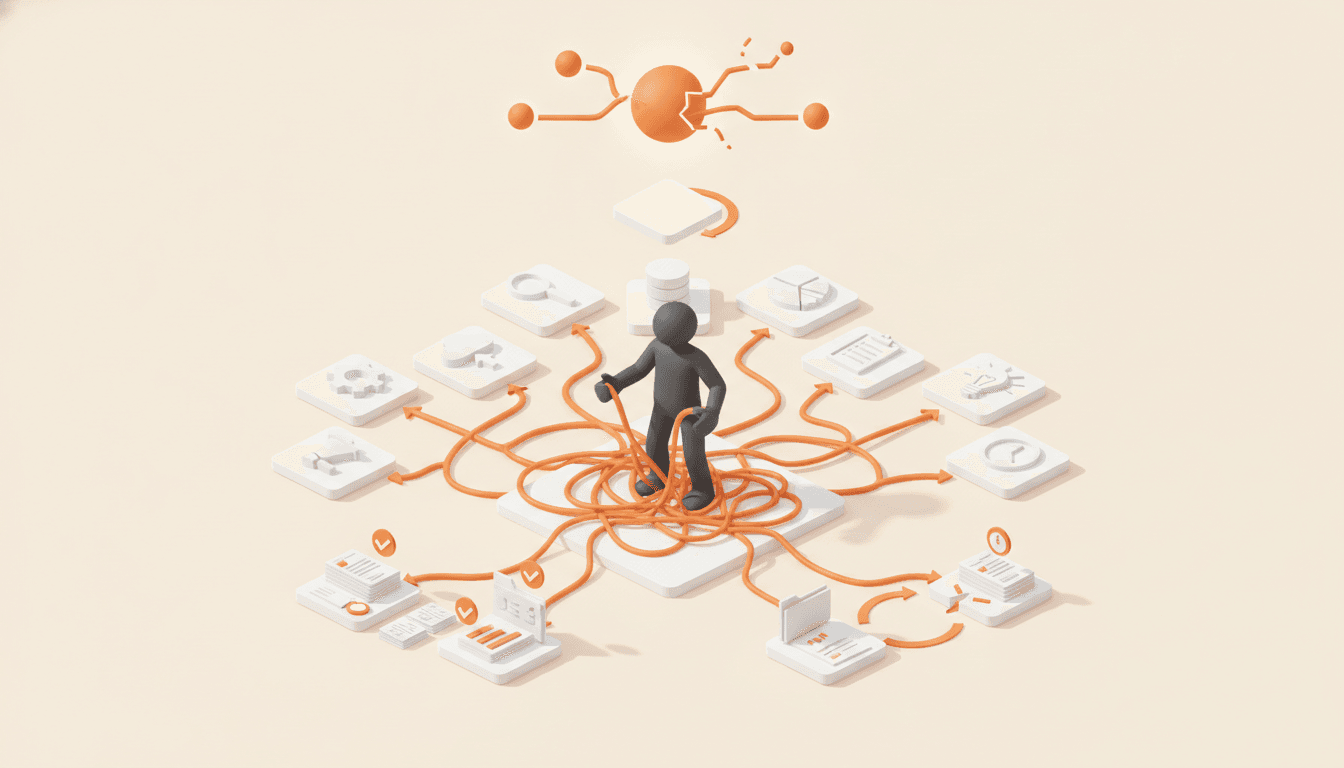
A dozen subscriptions, each bought for a good reason, and nobody owning the seams between them. The subscription total is not what SaaS sprawl costs you: the re-keying is.
What Is a Business Operating System? (Not the EOS Kind)
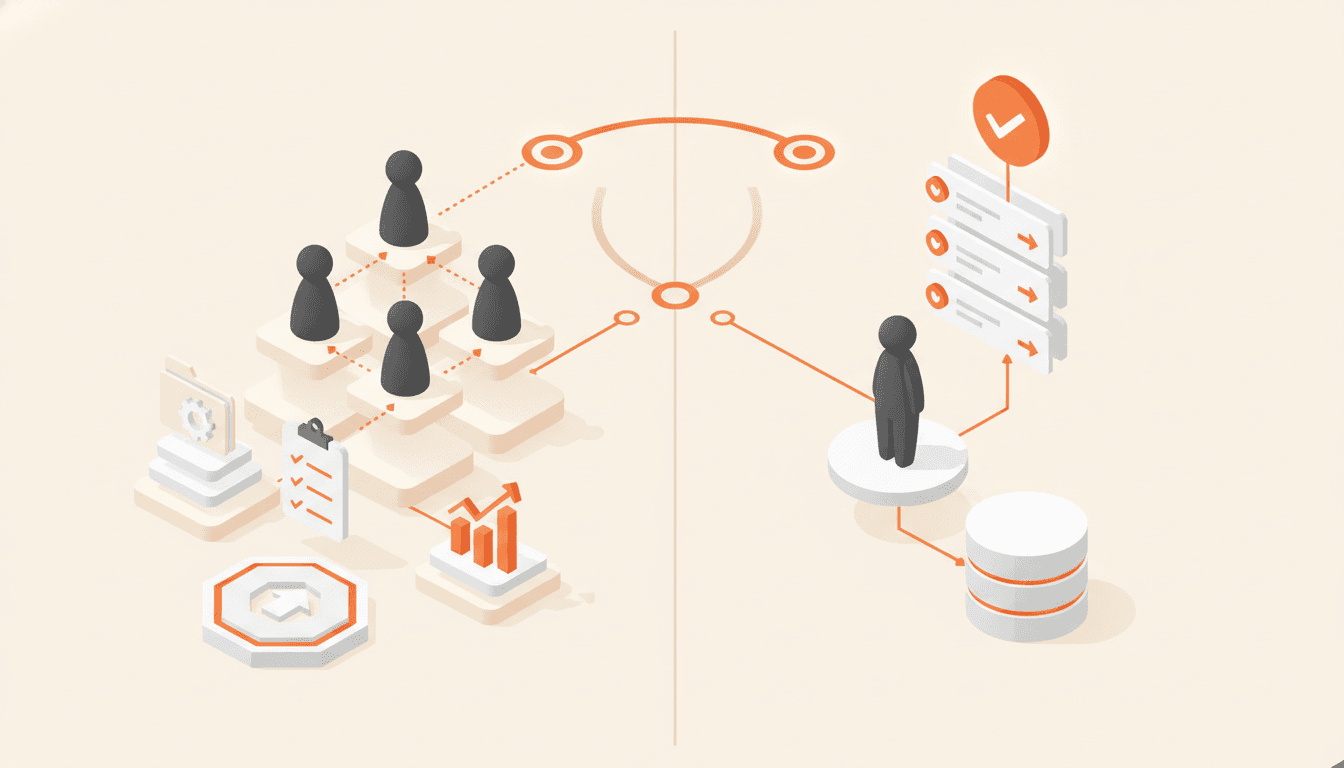
Two different things share the name. One is a management framework like EOS, and the other is one app, on one database, where every step can see the step before it.
A Custom App for Your Business Is Finally Realistic
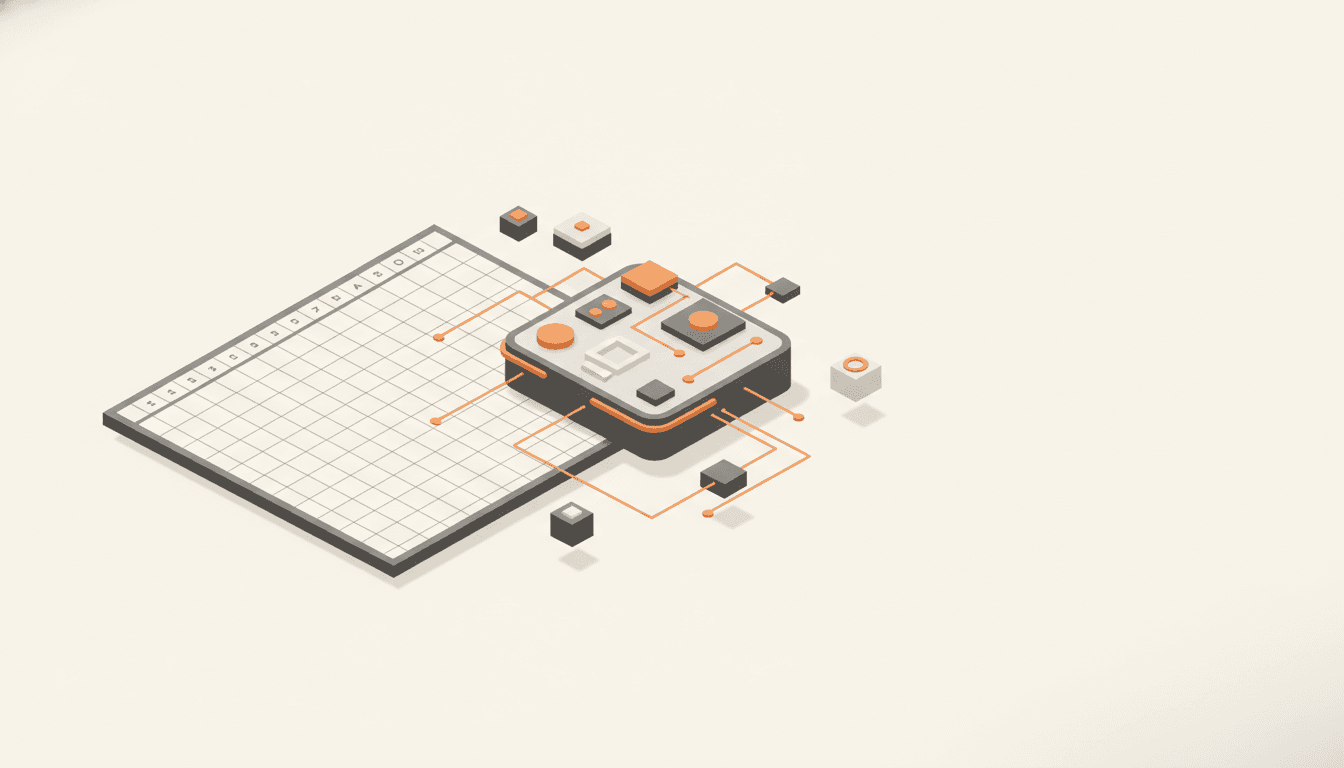
AI has dropped the cost and time of building custom business apps so far that a small company can now afford to build one around its single most painful workflow, instead of renting a stack of half-fitting subscriptions.
How much of your business runs on you?
Twelve questions, about three minutes. You get a score across six areas, the one carrying the most risk, and the first thing to fix.