How to Write Training Documentation New Hires Actually Use
By Derek Coffey · August 29, 2026
Training documentation works when it is gated: the few things a person does in week one sit up front, and everything else waits behind a link they choose to open. Write it for the person on day three, not the veteran on day three hundred. Give every module the reason the process exists, and put a one-page job aid where the work happens. Most of the craft is subtraction.
What Counts as Training Documentation?
Training documentation is the material that teaches someone to do a job for the first time, as opposed to the material that reminds a trained person what comes next. In practice that is four artifacts, not one.
- The module. Sequence, purpose and the first real tasks. Read once, in order.
- The reference. The SOP the module points at. Read forever, at the step.
- The job aid. One page where the work happens. Glanced at daily.
- The reinforcement. The drip, the refresher and the check that the person can do it.
Only the first is read once. The other three decide whether anyone still follows the process in March.
If you already have years of half-finished content and a platform nobody opens, sorting comes before writing: here is where to start with messy training content.
Training Documentation Is Not an SOP with a Nicer Font
An SOP tells a trained person what to do next. Training documentation is what makes them trained. The difference shows up in five places.
| Training documentation | SOP | |
|---|---|---|
| Written for | Someone doing it the first time | Someone who has done it before |
| Answers | Why, in what order, what good looks like | What to do next |
| Read | Once, in sequence | On demand, at the step |
| Goes stale when | The role or the reason changes | The screen or the tool changes |
| Proof it worked | A person did the task unwatched | The output matches the document |
The fourth row costs the most: tools change constantly, roles rarely, and a document carrying both ages at the speed of its faster half.
Keep the two in separate files, even when the same person writes both on the same afternoon.
Below the SOP sits the click-by-click layer, which is what a work instruction is. Push the screen-level steps down there and the module stays usable for years.
Gate the Depth: Must-Read Up Front, Detail Behind a Link
The most common objection we hear about a new tool or playbook is that it is too complicated for the team. It usually is. The fix is not deleting the detail, it is moving it.
At a nonprofit rolling out a workflow platform, the intimidating part was not the feature list but the empty screen: the blank space, as one program manager put it, does not really say much. Demo every field and you watch minds spin.
The gate has four parts.
- Name the primary functions. The 3 to 5 things this person does in week one. Everything else is detail, by definition.
- Write page one for those only. Short chapters, in the order the work happens.
- Title each link by its question. "How do I fix a duplicate customer record" beats "Appendix C".
- Make the linked file look finished. Branded and formatted, so the detail reads as a resource, not a scrap.
The reader has to be choosing to go deeper, not being forced there on page one.
Gating pays off later too: a screen change updates one linked file instead of staling a module the whole team already sat through.
Write for the Person on Day Three, Not Day Three Hundred
Every training document has two readers who want opposite things. The new hire wants sequence, vocabulary and permission to be slow. The veteran wants one answer in 10 seconds.
One nonprofit split the deliverable on that line: training workflows for new hires, plain references for veterans, from the same interviews.
Two craft rules hold up here. Name every screen the way it is labeled on the screen, not the way the org chart names it. Say what done looks like, and name the first mistake people make, because someone will make it on Thursday.
If a sentence only makes sense to someone who has already done the job, it belongs in the reference, not the module.
That is the discipline behind SOPs your team will actually follow. Written from memory, a document describes the ideal process. Written while somebody works, it describes the real one.
Add the Why to Every Module or It Will Not Stick
For every process we capture three things: the purpose, the decision points and the step-by-step. Purpose is the one writers skip, and it decides whether the steps get followed. If the team does not understand why a process matters, they will not follow it.
The why is not a mission statement. It is the consequence.
One owner took payables back for a few weeks after a key person left and found 500 to 800 dollars leaking every week from skipped audits and missed deductions. His math: up to 10,000 dollars a month, not from theft, but from a process nobody followed.
Put that number in the module and the audit step stops looking like busywork. Safety content earns the same treatment: every rule came from something that happened, and the incident story is what sticks.
Job Aids: The One-Page Version People Keep at the Desk
A job aid is a single page a trained person uses while doing the work: the trigger, the steps in order, the decision rule for the fork people get wrong, and who to ask when it goes sideways.
At the same nonprofit, a wave retro found resources stayed unclear until somebody made a one-pager. An electrical contractor printed his one-page operating system at 45 by 36 inches, big enough to read across a room.
Five things earn a spot on the page.
- The trigger that makes the page relevant
- The steps, 5 to 9 of them, in order
- The decision rule for the fork people get wrong
- Who to escalate to, and when to stop trying
- One link back to the full module
If it does not fit on one page, it is not a job aid, it is the module again.
Job aids exist because remembering is the expensive part. As one field operations lead put it, manual work is where steps get forgotten. Where the sequence is visual, a short recording beats a page, so choose between video SOPs and written SOPs per piece.
Build the Reinforcement, Not Just the Module
The module is the smallest part of making training stick, and it is where most budgets stop. Reinforcement is the scheduled contact after week one: a drip, a refresher, and a check that the person can still do the thing.
One residential cleaning company runs 55 technicians through 85 homes a day on an SOP platform account two years old, with no videos and no drip. Safety training happened only after something went wrong: they wait until there is a fire, the COO said, then send someone back through that part of the playbook.
Training that only happens after the incident is not training, it is an investigation.
Build the schedule when you build the module. A drip at day 7, day 30 and day 90 costs nothing but a calendar, and refreshers can be pre-written for the incidents you already get: one staffing branch sorts escalations into injury, altercation, theft, damage and intoxication, five modules to write before the next one.
Then track completion by name and date, which is what turns a folder into a program, a job covered in how to turn your SOPs into a training program.
How Do You Know the Training Documentation Worked?
You know it worked when someone you did not train does the task correctly without asking, and you can name the day it happened. Everything else is a proxy, and three are worth watching.
Completion logged with a name and a date. The unsupervised run, where the person states the purpose, names the decision points and works the steps without asking. And fewer interruptions to the owner on that process.
The honest cost is time from the people who are already busiest, usually 2 to 4 hours per process, plus one owner for republishing. Skip the owner and you get a binder.
For a new leader those proxies become gates, which is how a 30-60-90 day plan with the handoff built in turns training into a transfer of ownership. At The Systems Effect we build this material from recordings of the people doing the work.
Pick the module your last new hire needed most. Cut page one to the 3 to 5 things they do in week one and move the rest behind one link. That is an afternoon.
Frequently Asked Questions
What is training documentation?
Training documentation is the material that teaches a person to do a role for the first time: the module that carries sequence and purpose, the SOP it points at, the job aid, and the reinforcement after week one. It is written for someone who has never done the job, which separates it from a procedure written for someone who has.
What is the difference between training documentation and an SOP?
An SOP tells a trained person what to do next, and training documentation is what makes them trained. The SOP is read on demand at the step, while the module is read once in sequence and carries purpose, order and judgment calls. Keep them in separate files, because a vendor renaming a button should cost you one reference update, not a re-recorded module.
How long should a training module be?
One process per module, short enough to finish in one sitting, ending in a real task rather than a page view. If a person cannot get through it between two jobs, it is two modules. What matters more than length is page one: the 3 to 5 things they do in week one.
What should a job aid include?
A job aid includes the trigger, 5 to 9 steps in order, the decision rule for the fork people get wrong, who to escalate to, and a link back to the module. It fits on one page and lives where the work happens, taped to a desk or pinned in the channel. Anything that does not fit is module content.
How do you keep training materials current?
Separate the layers so a change lands in one file: screen-level steps in the reference, sequence and judgment in the module. Give every process one owner and a republishing trigger, usually a tool change, a process change or an incident. Re-recording with the person who does the work runs about 2 to 4 hours, so budget it.
Keep reading
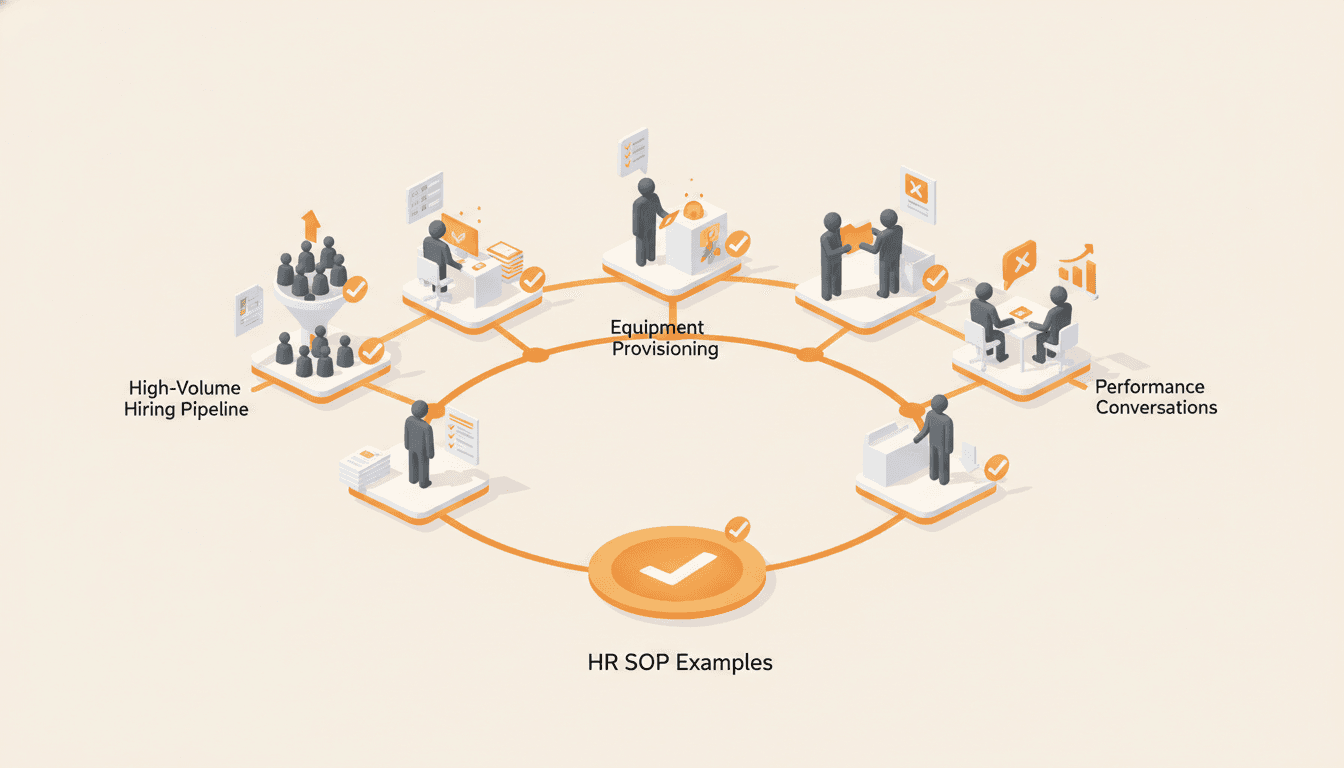
HR SOP Examples: Hiring and Onboarding Procedures That Get Used
Five real HR SOP examples from small businesses: a high-volume hiring pipeline, day-one setup, equipment provisioning, the exit handoff, and performance conversations that actually happen.
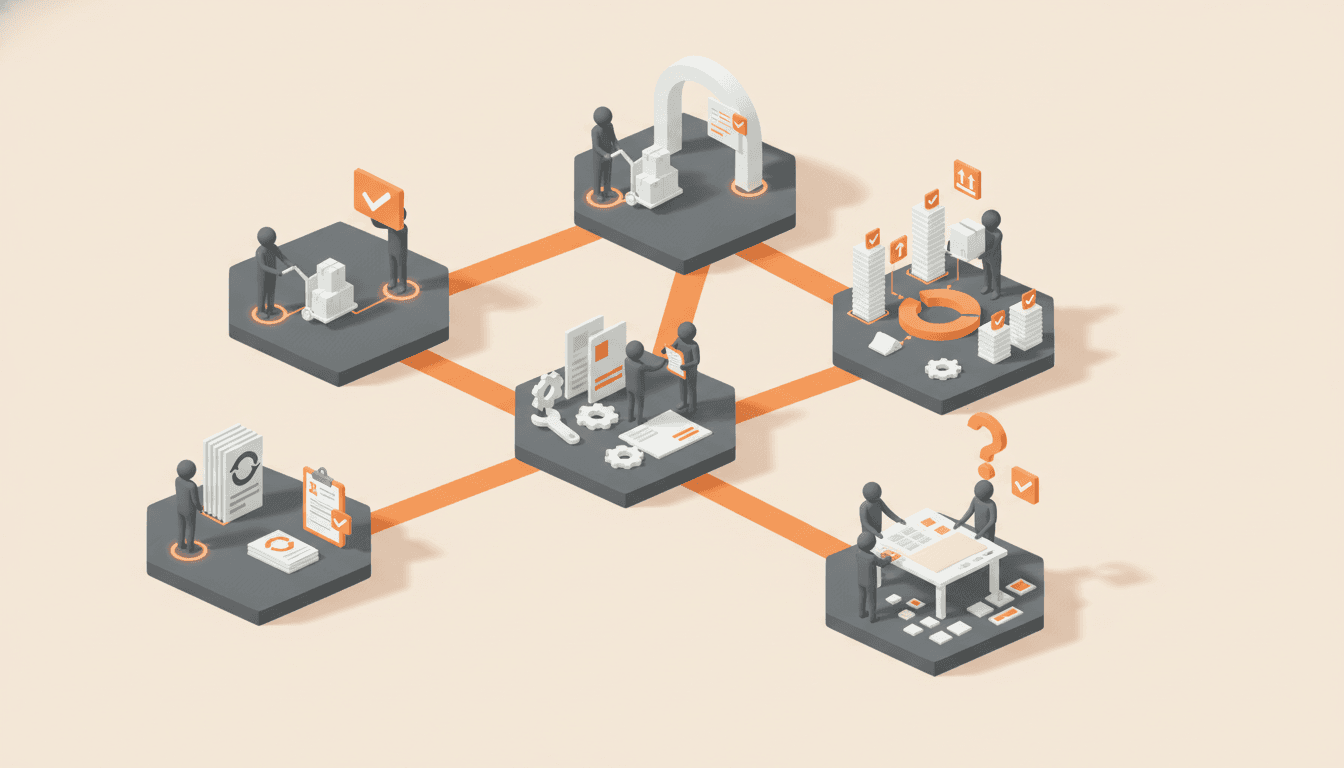
Inventory SOP Examples: Ordering, Receiving, and Counting Procedures
Five inventory SOP examples you can copy, covering the standing order day, receiving, job materials, cycle counts, and supply requests, plus how to write your own.
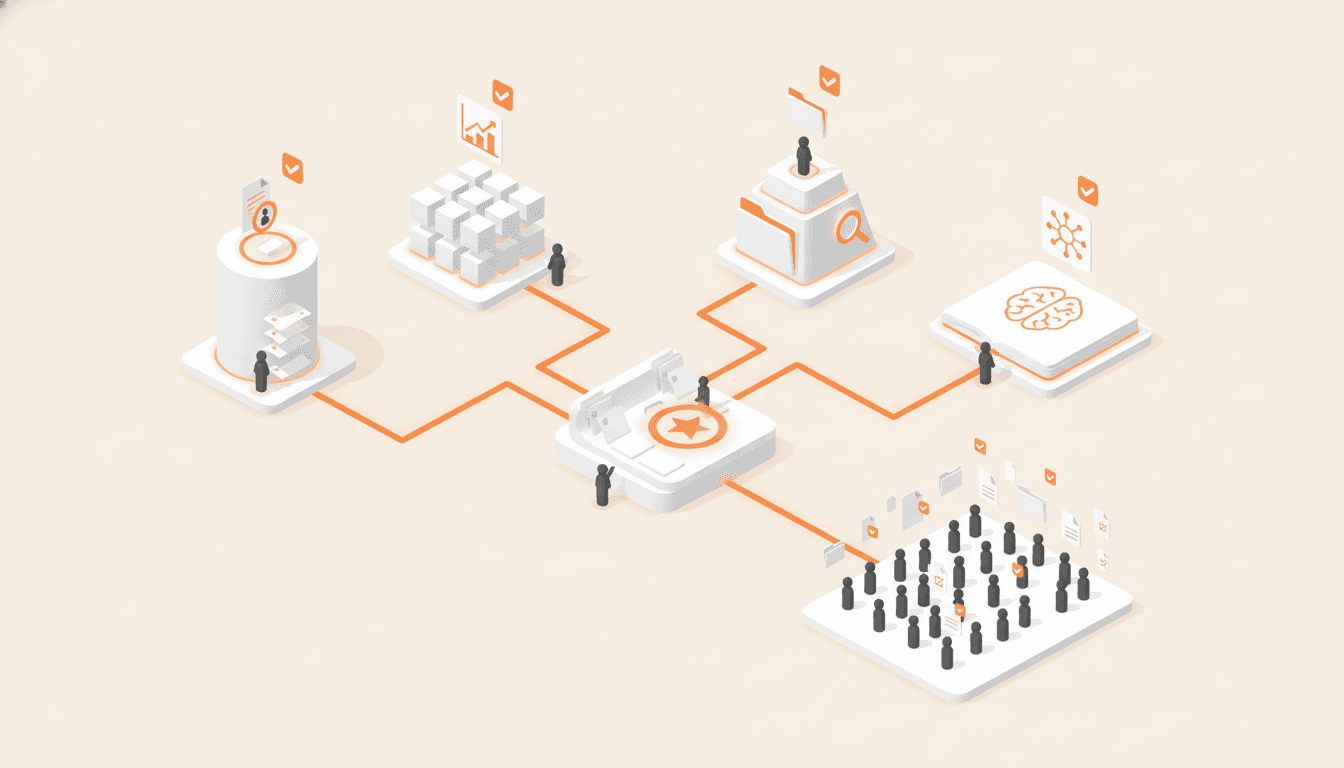
Knowledge Management for Small Business: A Practical Starting Point
Knowledge management at 40 people is not a software purchase. It is four kinds of knowledge, one home for each, an owner on every document, and an index you build before you write anything new.
Get one role out of one person's head in 14 days.
The interview guide, knowledge map and SOP templates we use on paid engagements. Free as Google Docs and Sheets.