
Process Mapping & Documentation
Every Task Needs an Owner and Someone Who Notices
By Derek Coffey · August 29, 2026
Responsible and accountable are two different jobs on the same task. The responsible person does the work. The accountable person is answerable for whether it got done, which means their real job is noticing the miss. Most small businesses assign the first and quietly skip the second, and that is why work with a clear owner still disappears.
Ownership alone does not catch anything
You already assigned it. One name, one task, no ambiguity about whose job it was. And you still found out three days late, from a customer, or from the person who was waiting on the output and finally got tired of waiting.
That is not an ownership failure. Ownership tells you who to ask afterward. It does not create the moment where anybody finds out in time to fix it.
The instinct at that point is to decide you have a discipline problem and go looking for someone to talk to. Almost every time we run this down with a client it turns out to be a system problem wearing a people problem's clothes: the task had an owner, the miss had nobody.
A task with an owner and no catch is a task you learn about from your customer.
What is the difference between responsible and accountable?
The responsible person performs the task. The accountable person answers for whether the task happened and is the one who has to notice when it did not. Responsibility can be shared across a few hands without much harm. Accountability cannot, because the moment two people are accountable, nobody is.
Here is the split as it works on a real step:
| Responsible | Accountable | |
|---|---|---|
| Answers | Who does this? | Who catches it if it does not happen? |
| The work | Performs the task | Checks the signal, chases the silence |
| How many | One or a few | Exactly one |
| Failure mode | Task skipped | Skip goes unnoticed |
Notice that the two columns fail differently. A responsible person having a bad week costs you one late task. A missing accountable person costs you every late task, forever, because nothing in the business is built to see them.
You need a name in the first column before the second one means anything, which is why this work sits downstream of a responsibility map built from the work rather than the org chart. Titles do not own tasks. People do.
Build the catch into the process, not the training
An owner of a small senior care home put this better than any framework we have read. Her building's daily failure mode was medication errors: the med tech gets pulled off the cart to give hands-on care, gets sidetracked, comes back, and steps get skipped.
Her fix was not another training session. It was a catch.
If a med is missed, the med tech prints an exception report at the end of shift. If that exception report does not get printed, the nurse is the one accountable for asking whether it was. Every task in the building got a responsible person doing it and a second person answerable for the miss. What she said she did not want was people saying they did not know they were supposed to do that.
If a miss is only visible to the person who missed it, it is not a miss anyone will fix.
Training tells people the right order. A catch decides what happens when the right order does not happen, and that is the only scenario that costs you money. It is the same logic that makes the difference between a documented shift and a safe one when you systemize a care home across three shifts.
The exception report pattern
Strip her fix down and it is three moving parts you can bolt onto almost any recurring task.
- Name the miss. Decide what specifically counts as the task not happening: a med not given, a ticket not closed, a resume not updated. Vague standards produce vague catches.
- Pick the smallest signal. Something has to exist when the miss happens, or fail to exist when it does not. A printed report, a status change, a one-word reply.
- Give the silence an owner. One named person is accountable for asking about the signal that never arrived. Silence is the part everyone forgets to assign.
Step three is the whole trick. Most businesses build the report and then leave nobody responsible for its absence, so a missing report reads exactly like a quiet week. The pattern only works when the absence of the signal is as loud as the signal.
Keep the catch cheap. If it takes longer than the task, people will route around it, and you will have documented a rule you cannot enforce.
What happens when three people touch a task and nobody owns it?
You get the resume problem. At one construction consulting firm, resumes are created by recruiting, updated by field operations, and needed by proposals. Roughly 700 proposals a year depend on those documents, and no single person owns the lifecycle from creation to current.
Nobody there was doing anything wrong. The work arrived from three directions and left through none of them. Their own internal verdict was that without designating a single person accountable, they were going to keep tripping over each other, which is a generous way to describe 700 chances a year to send out a stale document.
Three touchers is normal. Three touchers and zero accountable names is the defect, and it usually shows up in the library as duplicate entries and stale content, which is why the edit rules for a document end up being an ownership question rather than a software question.
Ask both questions on every step of the map
When we map a process, both questions get asked on every step, out loud, with the people who do the work in the room. Who is primarily responsible for that task, and who is accountable to make sure it got done. That second question is the one that finds the holes, because on plenty of steps nobody in the room has an answer for it and everybody hears the silence.
A client asked it in exactly those words on a call, and it has been part of how we map ever since.
The output is not a chart to admire. It is a list of steps where the accountable column is blank, sorted by what a miss costs you, and each blank one gets a name and a catch before you move on. That is also what makes a documented process measurable later, because an adherence number you can actually put on a scorecard needs a signal to count in the first place.
When the catch is one text message
At a staffing agency, dispatch fires the moment a paper ticket is handed to a worker, and after that the system knows nothing. No en route. No arrival. Nothing updates again.
The first news anyone gets is a site supervisor calling to ask where the worker is, and that call burns the morning: the supervisor calls the sales rep, the rep calls customer service, customer service calls operations, and operations finally calls the worker.
The fix proposed on that call was deliberately tiny. A text five minutes before shift asking are you on site, and if not, what is your ETA. Even a yes or no reply would do it, because then the office knows the worker responded eight minutes ago instead of guessing.
That is the whole shape of it. The responsible person is the worker, the accountable person is whoever is watching for a reply that does not arrive, and the catch is one message. Nobody needed new software or a policy, and the difference between this and surveillance is entirely in how it lands, which is the same ground you have to hold when you are getting a team to follow the documented way.
Pick the one task that burned you most recently. Write down the person responsible, the person who should have noticed, and the single cheapest signal that would have told them, all on one line. At The Systems Effect we ask both of those questions on every step we map for a client, and the second one is where the surprises live.
Frequently Asked Questions
What is the difference between responsible and accountable?
The responsible person does the task. The accountable person answers for whether it got done and is the one required to notice when it did not. Responsibility can be shared among a few people without breaking anything, but accountability has to land on exactly one name, because two accountable people means each assumes the other is watching.
How do you stop tasks from falling through the cracks?
Add a catch, not another reminder. Decide what counts as the task not happening, pick the smallest possible signal that appears or fails to appear, and give one named person the duty of asking about the missing signal. One senior care operator stopped medication errors this way: a missed med produces an exception report at end of shift, and if the report is not printed, the nurse is accountable for asking why. The catch, not the training, is what closes the gap.
Does a small business need a RACI chart?
Usually not. RACI assigns four labels to every task, responsible, accountable, consulted and informed, and in a business under about fifty people the last two columns become busywork nobody maintains. Ask the two questions that matter on every step instead: who does this, and who catches it if it does not happen. If you ever outgrow that, the two answers you already have are the ones a full RACI would keep anyway.
What is an exception report?
An exception report is a signal that fires only when something did not happen the way it was supposed to, rather than a report of everything that went fine. It works because it is small: the person doing the work produces it at the end of a shift or a day, and it lists only the misses. The important half is the second name attached to it. Someone has to be accountable for noticing when the exception report itself never shows up.
Keep reading
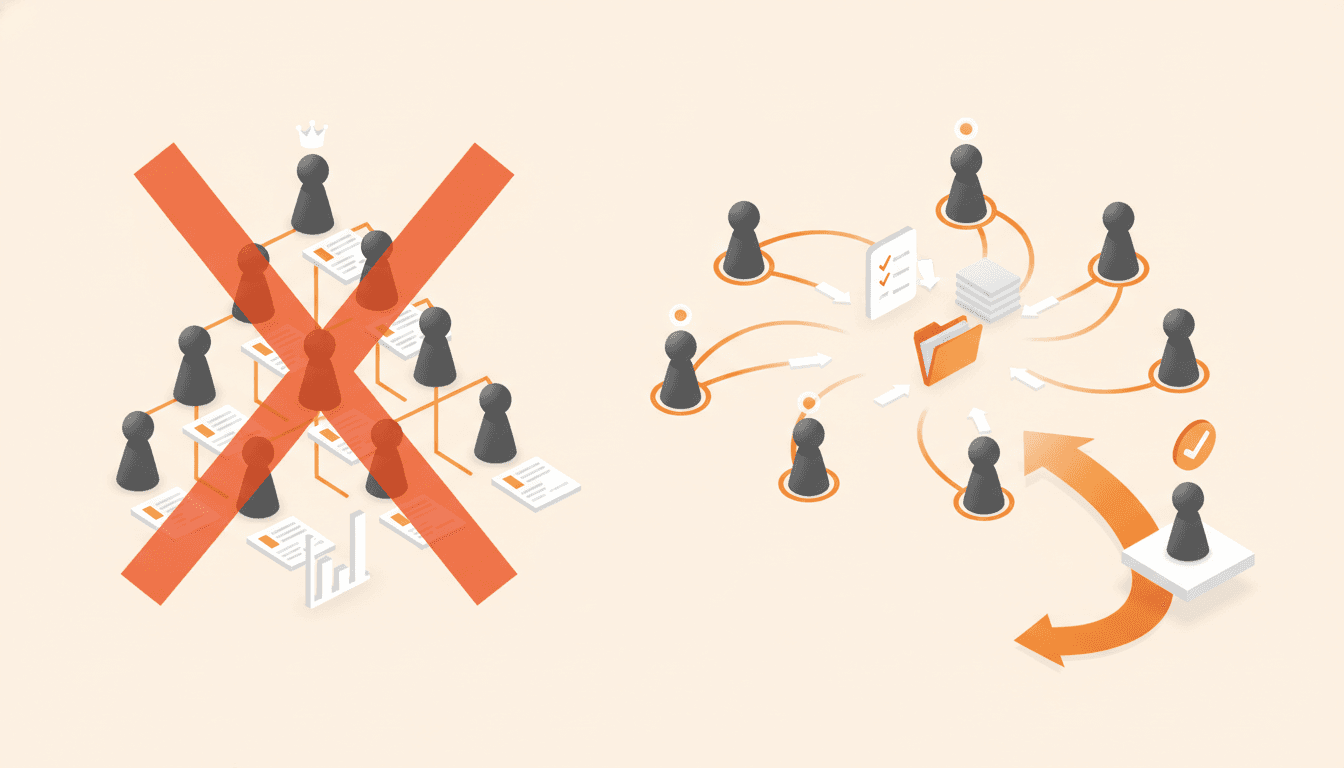
Your Org Chart Is Not How the Work Happens
An org chart shows reporting lines, not who owns the work, which is why systems built off the boxes end up documenting titles. Here is how to map roles and responsibilities starting from the work itself.
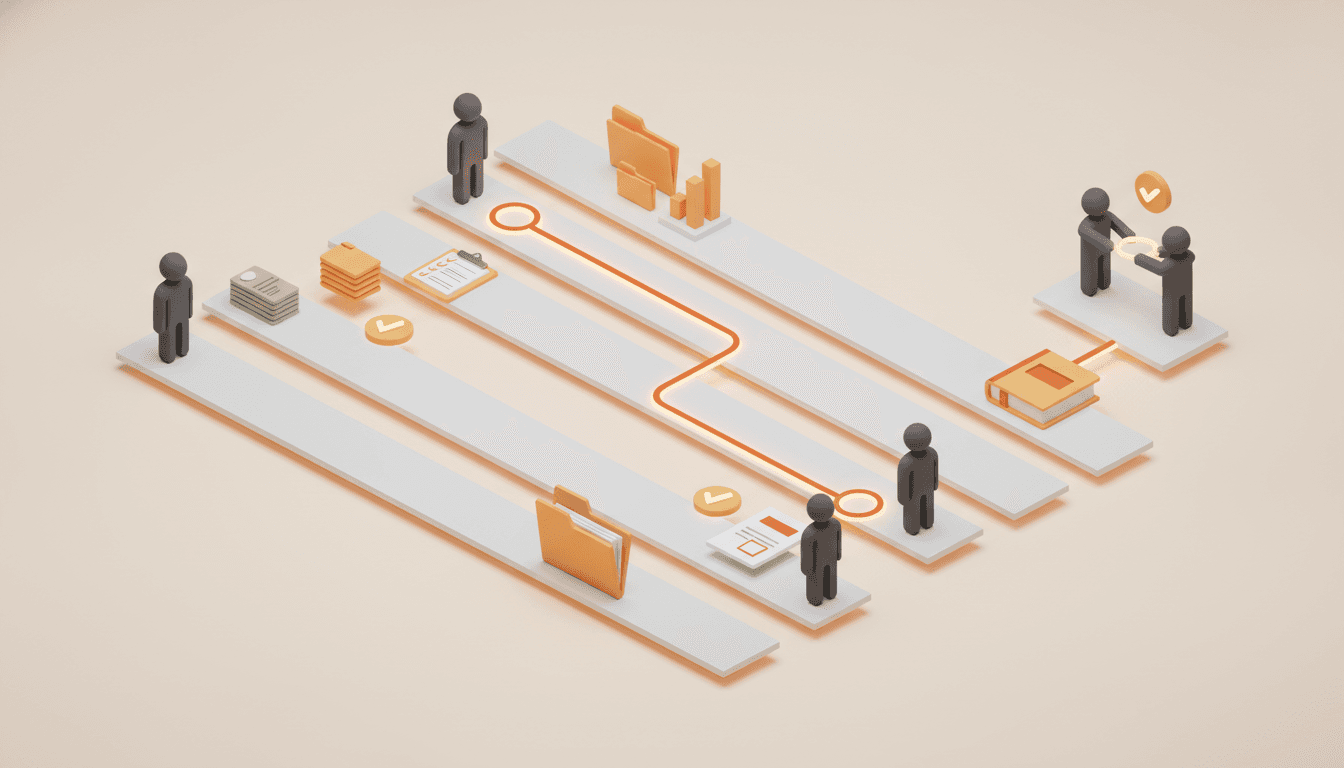
Swimlane Diagrams: How to Map Handoffs Between Departments
A swimlane diagram puts every step in the lane of whoever performs it, so the handoffs between departments finally become visible. Here is how to set up the lanes and write a rule for every crossing.
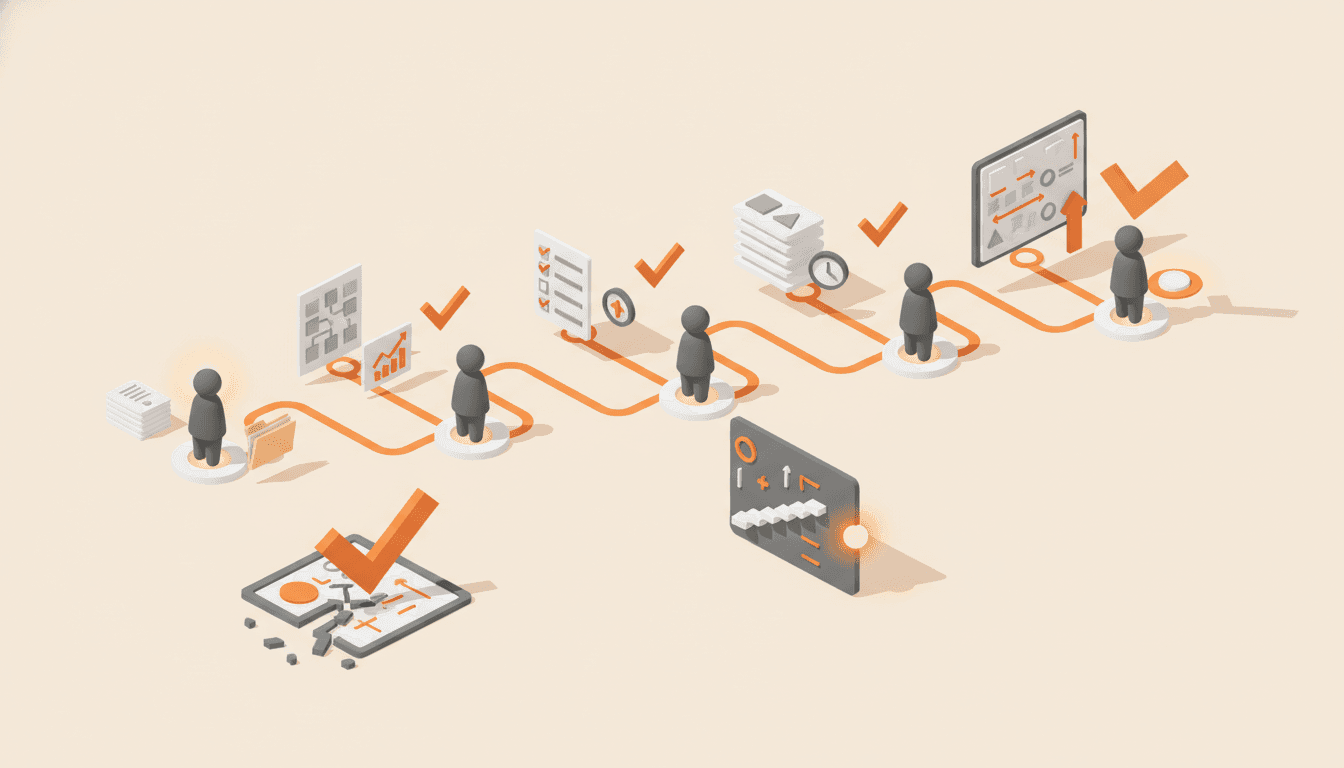
Value Stream Mapping for Small Business: A Practical Guide
A value stream map is a process map with a time written next to every step. Here is how to run one in five steps, and why a wall of steps ends arguments a dashboard never could.
Get one role out of one person's head in 14 days.
The interview guide, knowledge map and SOP templates we use on paid engagements. Free as Google Docs and Sheets.