
Process Mapping & Documentation
Your Process Map Is Already Out of Date. Here Is the Review That Fixes It.
By Derek Coffey · August 29, 2026
To review a process map, walk it left to right in front of the people who actually run the work, invite interruption at every box, park each disagreement as a note instead of solving it live, delete dead steps out loud, and close by reading the coverage list back and dating whatever is unfinished. This is not a proofreading pass. It is a working session, about an hour, where the diagram gets corrected by the hands on the work. Done that way, a map that has drifted for six months comes back to reality in one sitting.
Why Do Maps Drift Faster Than SOPs?
Because an SOP describes one person's job, so it only goes stale when that job changes. A map describes a chain: five roles, three tools, a dozen handoffs. Any one of those people can retire a tool on a Tuesday without telling anyone, and the map is wrong from that afternoon on.
We saw this in a recruiting map at a real estate wholesaling operation. It still showed a task board the team had abandoned months earlier. Asked what replaced it, the office manager said "My brain," then corrected herself: candidate folders now live in a shared drive, one per role.
The same session turned up a step running the other way, a hiring manager calling the candidate with a verbal offer before HR schedules the formal one. That step had run for months and appeared in no document.
A map that still shows the tool you retired last spring is not documentation, it is wall art with arrows.
Maps drift both ways at once, which is why the fix is a conversation and not an edit. Steps die quietly and nobody deletes them. Steps get born in a hallway and nobody draws them. It is the same pattern behind rules that change while nobody updates the SOP, just harder to spot, because a diagram looks authoritative.
How to Review a Process Map: Left to Right, Interruptions Welcome
The move that makes a review work is giving people explicit permission to cut you off. The standing instruction we open with is close to this every time: "I'm going to run through it, anything that needs to be talked about, interrupt me, we'll slap a note on it so we know we're going to have a list of the things that we need to talk through." Say it before the first box.
- Give the standing instruction. Thirty seconds promising interruptions get captured, not lost, buys an hour of honest correction.
- Start at the trigger. Begin at whatever kicks the process off and move one direction only. People correct a sequence far better than a list.
- Leave the layout alone. The line we repeat is "we'll put this all in the right spot and not really worry about the placement yet." One client answered it perfectly: "I'll just tell you how it goes and then you do your diagramming magic."
- Keep the pass moving. One stall on box four eats the hour and the last third never gets read.
If you are cleaning up crossing lines while somebody explains a handoff, you are not listening, and the version you produce will be tidy and wrong. The mechanics match a first build, covered in the complete guide to process mapping for a small business.
Say What You Think the Box Means, Then Get Corrected
Do not ask "is this right?" You will get a yes, because reading a diagram carefully is work and agreeing is free. State your interpretation instead: "Let me tell you what I think this is saying, and then we'll figure out where I'm off, because I probably am somewhere."
That phrasing puts a specific, wrong-ish claim on the table to push against, which is easier than asking someone to produce a correction from nothing. It also makes being wrong your job, not theirs.
In one hiring map, a branch asked whether multiple qualified candidates were available. The office manager wanted it moved earlier, since they never send more than one offer at a time. Saying out loud what the branch appeared to mean surfaced the reason it existed, which she had forgotten: it holds the losing candidates in reserve until the winner's negotiation closes.
Every box that survives a review should survive because somebody said why it is there, not because nobody objected. It is harder when you are mapping your processes without a consultant, because your team assumes you already know.
Delete Dead Steps Out Loud
Retired tools and dead steps come off the map live, with a one-word confirmation each time. "That just goes away." "Yeah." Then move.
Doing it out loud rather than tidying up later is social. Watch one deletion get accepted without argument and people start volunteering more.
Then batch the confirmations. One reviewer asked "anything besides the retired board on this one?" at each stage, took a one-word answer, and moved on. That cleared six dead steps in five minutes. Batch the small confirmations, and never debate a box you are about to delete.
Deletion has an archaeology problem worth respecting, though. In a disposition map, a "screen interest" box sat before the buyer walkthrough. The team said they do not screen at all: it runs open-house style, and vetting happens only after an offer. That box existed because one buyer had once gone around them on a deal, and the current answer is that the odds are low enough to accept, the notarized contract protects them, and anyone who tries it is quietly never invited back.
The box came off and the policy underneath it got written down for the first time, which is what a process audit that separates real documents from fiction is hunting for.
Park the Arguments, Do Not Solve Them Live
The fastest way to lose a review is to let one disputed box become a twenty-minute design meeting. Park notes as stickies on the canvas and clean them at the end, so the walkthrough never stalls and nothing gets forgotten.
A disagreement about how the process should work is a note, not an edit.
That rule keeps two truths from fighting. When the same office manager described the offer sequence, the designed rule and the lived reality both went on the map, because volume had changed the behavior: "We've been hiring so fast that we don't even have time to get back to candidates." Neither version is a lie.
In a budget review elsewhere, we recorded the current state (she chases the field director weekly and he usually does not know) next to the ideal state (they report monthly and she stops asking), plus the smallest change that closes the gap: one extra person in a weekly meeting, once a month, for ten minutes. Holding both in view is the reason to ask how it works before asking how it should.
What Replaced the Step You Just Deleted?
A deletion without a replacement question leaves a hole nobody notices until a new hire falls in it. Every time a step comes off, ask what happens now instead. "My brain" is a real answer, and the one you want most, because the follow-up turns it into folders in a shared drive, one per role.
Sometimes the honest answer is nothing, on purpose. Reviewing three outreach lists, one showed a follow-up sequence and the others did not, which looked like a documentation gap. It was not.
That team does not follow up: "We only cater to the ones that actually respond because we do a lot of volume." The map got corrected to say so, rather than gaining a step nobody performs.
Ask whether there should be one before you add one. A map of an aspirational process is as useless as a map of a retired one. It just fails later.
Close on the Coverage List and the Next Slot
End by reading the priority list back item by item and agreeing on each: reviewing contracts, covered; invoices, yes; timesheets, yes; resource planning, the one nobody is sure about. Then clean the parked stickies while everyone is still in the room.
The unfinished item gets a date and a time, not a promise. Better, it gets an existing meeting redirected at it: "Are you available at 12 on Monday? I have a meeting with the controller. I'm going to change the direction of that meeting."
Booking a new slot adds friction that kills follow-up. Dating the gap is what makes reviews cumulative instead of episodic, and it feeds straight into what you actually do with a finished process map.
A process map is not a deliverable you finish. It is a claim about how work happens, and claims expire. When we run these review sessions for clients at The Systems Effect, the redrawn map is rarely the valuable part, the corrections are.
Pull up your oldest map this week and read it out loud to one person who does the work. Count the boxes they do not recognize.
Frequently Asked Questions
How often should you review a process map?
Quarterly is the honest floor for any process a team runs weekly, and sooner if the tooling changed or headcount moved. In our engagements, maps go visibly wrong within months: a retired task board, a screening step nobody performs, an offer call that appears nowhere. If a map has not been read out loud in six months, treat it as a draft rather than a record.
Who should be in a process map review?
The people whose hands are on the work, plus one person who can decide when the map is wrong. Managers describe the process as designed, practitioners describe it as run, and the gap between those two is most of what a review is for. Keep the group small enough that everyone speaks, and split the session when the person who owns the tooling is not the person who owns the outcome.
What do you do with steps nobody performs anymore?
Delete them out loud, with a one-word confirmation, and then ask what replaced them. Batching that question at each stage cleared six dead steps in five minutes in one review. Ask why the step was ever added first, because the answer is often an unwritten policy worth keeping after the box goes.
How do you keep a process map current while you are hiring fast?
Shorten the review loop on the lanes hiring touches, and record both the designed rule and the volume-spike behavior. One operation onboarded ten people at once and the structured version of onboarding evaporated, welcome kits and gifts included. A map that only shows the calm version gets ignored in exactly the month you need it most.
Keep reading

How to Run a Process Mapping Session Your Team Doesn't Dread
Run it with one practitioner on a screen share and two facilitators, one building the map live and one probing what gets skipped. Here is the format, the prompts that surface real work, and what to do in the 48 hours after.

How to Streamline a Process: Turn a 15-Minute Task into 5
Streamlining is not a software purchase. It is a stopwatch, four buckets, and one piece of arithmetic that turns three saved minutes into a number your leadership team will actually fund.
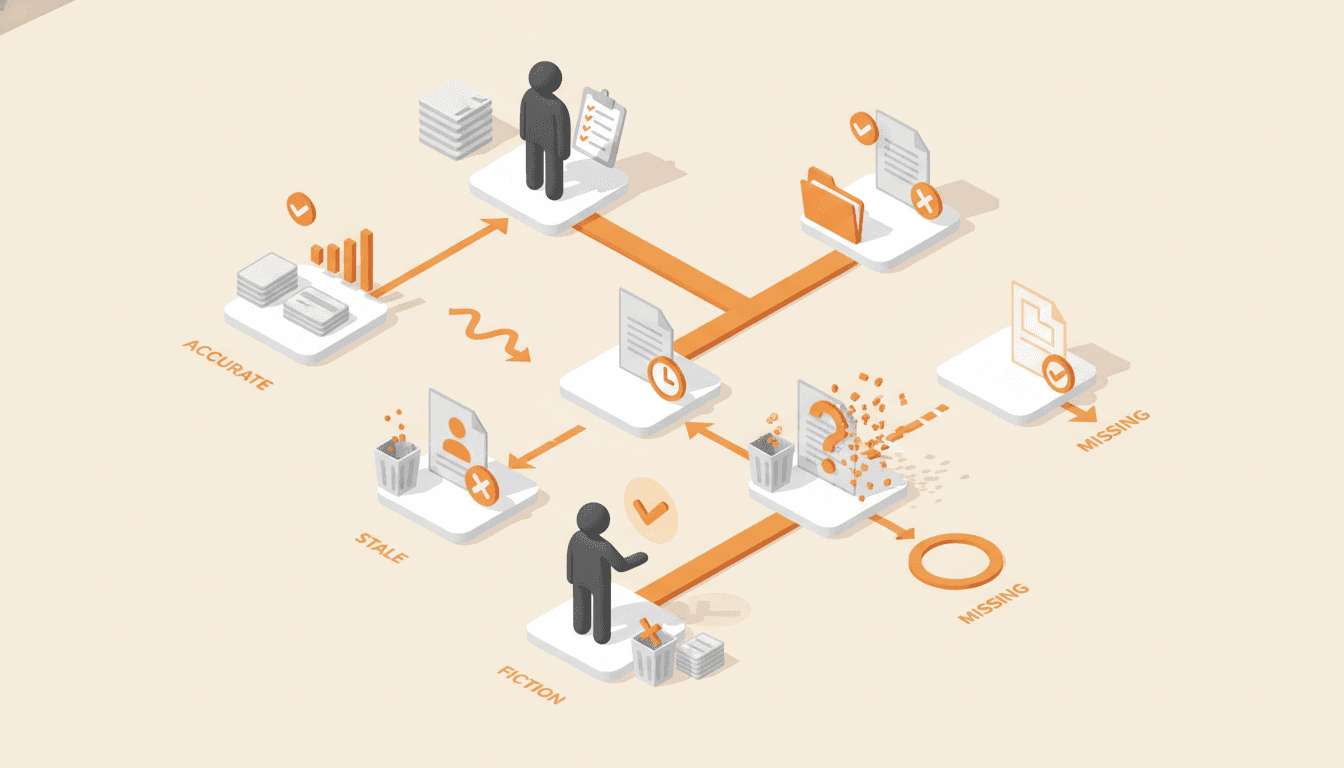
The Process Audit Checklist: Find Out Which Documents Are Fiction
Most companies have documentation, and far fewer have documentation that matches how the work gets done. This audit sorts every process into accurate, stale, fiction, or missing, and tells you what to delete.
Get one role out of one person's head in 14 days.
The interview guide, knowledge map and SOP templates we use on paid engagements. Free as Google Docs and Sheets.